When Did Polio Start Again in the Us

The history of polio (poliomyelitis) infections began during prehistory. Although major polio epidemics were unknown before the 20th century,[i] the affliction has caused paralysis and decease for much of human being history. Over millennia, polio survived quietly as an endemic pathogen until the 1900s when major epidemics began to occur in Europe.[1] Soon after, widespread epidemics appeared in the remainder of the world. By 1910, frequent epidemics became regular events throughout the developed world primarily in cities during the summer months. At its peak in the 1940s and 1950s, polio would paralyze or kill over half a million people worldwide every yr.[2]
The fearfulness and the commonage response to these epidemics would give rise to extraordinary public reaction and mobilization spurring the evolution of new methods to forbid and care for the illness and revolutionizing medical philanthropy. Although the development of two polio vaccines has eliminated wild poliomyelitis in all but two countries (Afghanistan and Islamic republic of pakistan),[3] [iv] the legacy of poliomyelitis remains in the development of modern rehabilitation therapy and in the rising of disability rights movements worldwide.
Early history [edit]
Ancient Egyptian paintings and carvings depict otherwise healthy people with withered limbs, and children walking with canes at a immature age.[5] It is theorized that the Roman Emperor Claudius was stricken equally a child, and this acquired him to walk with a limp for the rest of his life.[6] Perchance the primeval recorded case of poliomyelitis is that of Sir Walter Scott. In 1773, Scott was said to accept developed "a severe teething fever which deprived him of the power of his right leg".[7] At the time, polio was not known to medicine. A retrospective diagnosis of polio is considered to be strong due to the detailed account Scott later fabricated,[8] and the resultant lameness of his right leg had an important effect on his life and writing.[9]
The symptoms of poliomyelitis have been described by many names. In the early nineteenth century the disease was known variously as: Dental Paralysis, Infantile Spinal Paralysis, Essential Paralysis of Children, Regressive Paralysis, Myelitis of the Inductive Horns, Tephromyelitis (from the Greek tephros, meaning "ash-gray") and Paralysis of the Morning time.[10] In 1789 the kickoff clinical description of poliomyelitis was provided by the British doc Michael Underwood—he refers to polio as "a debility of the lower extremities".[eleven] The start medical report on poliomyelitis was past Jakob Heine, in 1840; he called the illness Lähmungszustände der unteren Extremitäten ("Paralysis of the lower Extremities").[12] Karl Oskar Medin was the beginning to empirically study a poliomyelitis epidemic in 1890.[thirteen] This work, and the prior classification by Heine, led to the disease being known as Heine-Medin disease.
Epidemics [edit]
Major polio epidemics were unknown before the 20th century; localized paralytic polio epidemics began to appear in Europe and the Usa around 1900.[i] The first report of multiple polio cases was published in 1843 and described an 1841 outbreak in Louisiana. A fifty-yr gap occurs before the next U.Due south. report—a cluster of 26 cases in Boston in 1893.[i] The start recognized U.S. polio epidemic occurred the following twelvemonth in Vermont with 132 full cases (18 deaths), including several cases in adults.[xiii] Numerous epidemics of varying magnitude began to appear throughout the land; past 1907 approximately two,500 cases of poliomyelitis were reported in New York Urban center.[14]
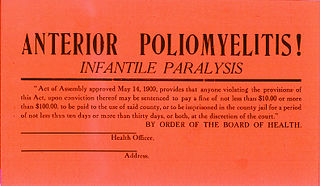
This cardboard placard was placed in windows of residences where patients were quarantined due to poliomyelitis. Violating the quarantine club or removing the placard was punishable by a fine of upwardly to U.s.$100 in 1909 (equivalent to $three,016 in 2021).
Polio was a plague. One 24-hour interval yous had a headache and an hour after yous were paralyzed. How far the virus crept upward your spine adamant whether you could walk afterward or even exhale. Parents waited fearfully every summer to meet if it would strike. One case turned upwardly and and so some other. The count began to climb. The city closed the pond pools and we all stayed home, cooped indoors, shunning other children. Summer seemed like winter then.[15]
Richard Rhodes, A Hole in the World
On Sabbatum, June 17, 1916, an official proclamation of the being of an epidemic polio infection was made in Brooklyn, New York. That year, at that place were over 27,000 cases and more than than 6,000 deaths due to polio in the U.s., with over ii,000 deaths in New York City solitary.[xvi] The names and addresses of individuals with confirmed polio cases were published daily in the press, their houses were identified with placards, and their families were quarantined.[17] Dr. Hiram G. Hiller, Jr. was one of the physicians in several cities who realized what they were dealing with, but the nature of the disease remained largely a mystery. The 1916 epidemic caused widespread panic and thousands fled the city to nearby mountain resorts; moving picture theaters were airtight, meetings were canceled, public gatherings were well-nigh nonexistent, and children were warned non to drink from water fountains, and told to avert entertainment parks, swimming pools, and beaches.[16] From 1916 onward, a polio epidemic appeared each summertime in at least one part of the state, with the nigh serious occurring in the 1940s and 1950s.[1] In the epidemic of 1949, 42,173 cases were reported in the United states of america and 2,720 deaths from the disease occurred. Canada and the United Kingdom were likewise affected.[xviii] [19]
Prior to the 20th century, polio infections were rarely seen in infants before 6 months of historic period, and most cases occurred in children 6 months to four years of age.[xx] Young children who contract polio generally suffer simply balmy symptoms, but every bit a result they become permanently allowed to the illness.[21] In developed countries during the late 19th and early 20th centuries, improvements were being fabricated in customs sanitation, including improved sewage disposal and clean water supplies. Better hygiene meant that infants and immature children had fewer opportunities to come across and develop immunity to polio. Exposure to poliovirus was therefore delayed until tardily childhood or adult life, when it was more probable to accept the paralytic form.[xx]
In children, paralysis due to polio occurs in one in 1,000 cases, while in adults, paralysis occurs in 1 in 75 cases.[22] By 1950, the peak age incidence of paralytic poliomyelitis in the Usa had shifted from infants to children aged 5 to ix years; almost one-third of the cases were reported in persons over 15 years of age.[23] Accordingly, the rate of paralysis and expiry due to polio infection also increased during this time.[one] In the The states, the 1952 polio epidemic was the worst outbreak in the nation's history, and is credited with heightening parents' fears of the affliction and focusing public awareness on the demand for a vaccine.[24] Of the 57,628 cases reported that year, iii,145 died and 21,269 were left with mild to disabling paralysis.[24] [25]
Historical treatments [edit]
In the early on 20th century—in the absence of proven treatments—a number of odd and potentially unsafe polio treatments were suggested. In John Haven Emerson's A Monograph on the Epidemic of Poliomyelitis (Infantile Paralysis) in New York City in 1916 [26] one suggested remedy reads:
Requite oxygen through the lower extremities, by positive electricity. Frequent baths using almond meal, or oxidising the water. Applications of poultices of Roman chamomile, glace elm, arnica, mustard, cantharis, amygdalae dulcis oil, and of special merit, spikenard oil and Xanthoxolinum. Internally utilise caffeine, Fl. Kola, dry out muriate of quinine, elixir of cinchone, radium water, chloride of gilt, liquor calcis and wine of pepsin.[27]
Post-obit the 1916 epidemics and having experienced piffling success in treating polio patients, researchers fix out to discover new and better treatments for the disease. Between 1917 and the early 1950s, several therapies were explored in an effort to prevent deformities, including hydrotherapy and electrotherapy.[ citation needed ]
In 1939, Albert Sabin reported that "In the experiments reported in the present communication it was plant that vitamin C, both natural and synthetic preparations, had no consequence on the course of experimental poliomyelitis induced by nasal instillation of the virus."[28] [29]
Surgical treatments such as nerve grafting, tendon lengthening, tendon transfers, and limb lengthening and shortening were used extensively during this fourth dimension.[30] [31] Patients with residual paralysis were treated with braces and taught to compensate for lost function with the assistance of calipers, crutches and wheelchairs. The employ of devices such as rigid braces and body casts, which tended to cause musculus cloudburst due to the limited movement of the user, were also touted equally effective treatments.[32] Massage and passive motion exercises were as well used to care for polio victims.[31] Most of these treatments proved to be of little therapeutic value, all the same several effective supportive measures for the treatment of polio did sally during these decades including the iron lung, an anti-polio antibody serum, and a treatment regimen developed past Sister Elizabeth Kenny.[33]
Fe lung [edit]

This iron lung was donated to the CDC by the family of Barton Hebert of Covington, Louisiana, who had used the device from the late 1950s until his death in 2003.
The first iron lung used in the treatment of polio victims was invented by Philip Drinker, Louis Agassiz Shaw, and James Wilson at Harvard, and tested October 12, 1928, at Children'due south Infirmary, Boston.[34] The original Drinker fe lung was powered by an electric motor attached to two vacuum cleaners, and worked by irresolute the pressure within the car. When the force per unit area is lowered, the chest cavity expands, trying to fill this partial vacuum. When the pressure level is raised the chest cavity contracts. This expansion and wrinkle mimics the physiology of normal breathing. The design of the iron lung was subsequently improved by using a bellows attached directly to the machine, and John Haven Emerson modified the blueprint to make production less expensive.[34] The Emerson Iron Lung was produced until 1970.[35] Other respiratory aids were used, such as the Bragg-Paul Pulsator and the "rocking bed" for patients with less critical breathing difficulties.[36]
During the polio epidemics, the iron lung saved many thousands of lives, merely the machine was large, cumbersome and very expensive:[37] in the 1930s, an atomic number 26 lung toll about $1,500—about the same price equally the average dwelling house.[38] The cost of running the machine was also prohibitive, as patients were encased in the metallic chambers for months, years and sometimes for life.[35] Fifty-fifty with an fe lung, the fatality rate for patients with bulbar polio exceeded 90%.[39]
These drawbacks led to the development of more modernistic positive-pressure ventilators and the utilize of positive-pressure ventilation by tracheostomy. Positive pressure ventilators reduced mortality in bulbar patients from 90% to 20%.[40] In the Copenhagen epidemic of 1952, big numbers of patients were ventilated by hand ("bagged") past medical students and anyone else on manus considering of the large number of bulbar polio patients and the small number of ventilators available.[41]
Passive immunotherapy [edit]
In 1950 William Hammon at the University of Pittsburgh isolated serum, containing antibodies confronting poliovirus, from the claret of polio survivors.[33] The serum, Hammon believed, would foreclose the spread of polio and to reduce the severity of illness in polio patients.[42] Between September 1951 and July 1952 nearly 55,000 children were involved in a clinical trial of the anti-polio serum.[43] The results of the trial were promising; the serum was shown to exist nearly eighty% effective in preventing the development of paralytic poliomyelitis, and protection was shown to terminal for 5 weeks if given under tightly controlled circumstances.[44] The serum was likewise shown to reduce the severity of the disease in patients who adult polio.[33]
The large-scale use of antibiotic serum to prevent and treat polio had a number of drawbacks, nevertheless, including the observation that the immunity provided past the serum did not concluding long, and the protection offered by the antibiotic was incomplete, that re-injection was required during each epidemic outbreak, and that the optimal time frame for administration was unknown.[42] The antibiotic serum was widely administered, but obtaining the serum was an expensive and time-consuming procedure, and the focus of the medical community before long shifted to the development of a polio vaccine.[45]
Kenny regimen [edit]
Early on direction practices for paralyzed muscles emphasized the demand to rest the affected muscles and suggested that the application of splints would preclude tightening of musculus, tendons, ligaments, or peel that would prevent normal movement. Many paralyzed polio patients lay in plaster trunk casts for months at a time. This prolonged casting often resulted in atrophy of both afflicted and unaffected muscles.[5]
In 1940, Sister Elizabeth Kenny, an Australian bush nurse from Queensland, arrived in N America and challenged this approach to treatment. In treating polio cases in rural Commonwealth of australia between 1928 and 1940, Kenny had developed a form of concrete therapy that—instead of immobilizing affected limbs—aimed to salve pain and spasms in polio patients through the utilize of hot, moist packs to salve musculus spasm and early activity and practise to maximize the force of unaffected muscle fibers and promote the neuroplastic recruitment of remaining nerve cells that had not been killed past the virus.[32] Sis Kenny later settled in Minnesota where she established the Sister Kenny Rehabilitation Institute, get-go a globe-broad cause to advocate her system of treatment. Slowly, Kenny's ideas won credence, and by the mid-20th century had get the authentication for the handling of paralytic polio.[30] In combination with antispasmodic medications to reduce muscular contractions, Kenny'due south therapy is still used in the treatment of paralytic poliomyelitis.
In 2009 as part of the Q150 celebrations, the Kenny regimen for polio treatment was appear every bit i of the Q150 Icons of Queensland for its role equally an iconic "innovation and invention".[46]
Vaccine evolution [edit]
In 1935 Maurice Brodie, a research banana at New York University and William Hallock Park of the New York City Department of Wellness, attempted to produce a polio vaccine, procured from virus in ground up monkey spinal cords, and killed by formaldehyde. Brodie offset tested the vaccine on himself and several of his assistants. He then gave the vaccine to three grand children. Many developed allergic reactions, but none of the children developed an immunity to polio.[47] During the tardily 1940s and early 1950s, a research group, headed by John Enders at the Boston Children's Infirmary, successfully cultivated the poliovirus in human tissue. This significant breakthrough ultimately immune for the development of the polio vaccines. Enders and his colleagues, Thomas H. Weller and Frederick C. Robbins, were recognized for their labors with the Nobel Prize in 1954.[48]
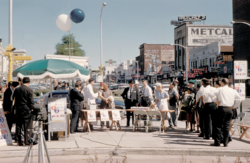
Two vaccines are used throughout the earth to combat polio. The first was developed by Jonas Salk, start tested in 1952 using the HeLa cell, and announced to the globe by Salk on April 12, 1955.[45] The Salk vaccine, or inactivated poliovirus vaccine (IPV), consists of an injected dose of killed poliovirus. In 1954, the vaccine was tested for its ability to forbid polio; its field trials grew to be the largest medical experiment in history. In 1955, it was called for use throughout the Usa. By 1957, post-obit mass immunizations promoted past the March of Dimes, the annual number of polio cases in the Usa was reduced, from a peak of most 58,000 cases, to five,600 cases.[thirteen]
Eight years later Salk's success, Albert Sabin adult an oral polio vaccine (OPV) using alive but weakened (attenuated) virus.[49] Human trials of Sabin's vaccine began in 1957 and it was licensed in 1962. Following the evolution of oral polio vaccine, a second wave of mass immunizations led to a farther reject in the number of cases: by 1961, just 161 cases were recorded in the United States.[50] The final cases of paralytic poliomyelitis caused by endemic transmission of poliovirus in the United states of america were in 1979, when an outbreak occurred among the Amish in several Midwestern states.[51]
Legacy [edit]
Early in the twentieth century polio became the world'due south most feared disease.[ citation needed ] The disease hit without alert, tended to strike white, affluent individuals, required long quarantine periods during which parents were separated from children: it was impossible to tell who would get the disease and who would be spared.[thirteen] The consequences of the disease left polio victims marked for life, leaving behind brilliant images of wheelchairs, crutches, leg braces, breathing devices, and plain-featured limbs. Nevertheless, polio changed non only the lives of those who survived information technology, merely also affected profound cultural changes: the emergence of grassroots fund-raising campaigns that would revolutionize medical philanthropy, the ascension of rehabilitation therapy and, through campaigns for the social and civil rights of the disabled, polio survivors helped to spur the modernistic disability rights move.
In improver, the occurrence of polio epidemics led to a number of public health innovations. Ane of the most widespread was the proliferation of "no spitting" ordinances in the United States and elsewhere.[52]
Philanthropy [edit]
In 1921 Franklin D. Roosevelt became totally and permanently paralyzed from the waist down. Although the paralysis (whether from poliomyelitis, every bit diagnosed at the time, or from Guillain–Barré syndrome) had no cure at the time, Roosevelt, who had planned a life in politics, refused to have the limitations of his disease. He tried a wide range of therapies, including hydrotherapy in Warm Springs, Georgia (see below). In 1938 Roosevelt helped to found the National Foundation for Infantile Paralysis (at present known as the March of Dimes), that raised coin for the rehabilitation of victims of paralytic polio, and was instrumental in funding the evolution of polio vaccines. The March of Dimes changed the way it approached fund-raising. Rather than soliciting big contributions from a few wealthy individuals, the March of Dimes sought small donations from millions of individuals. Its hugely successful fund-raising campaigns collected hundreds of millions of dollars—more than all of the U.S. charities at the time combined (with the exception of the Scarlet Cross).[53] By 1955 the March of Dimes had invested $25.v one thousand thousand in enquiry;[54] funding both Jonas Salk's and Albert Sabin's vaccine development; the 1954–55 field trial of vaccine, and supplies of free vaccine for thousands of children.[38]
In 1952, during the worst recorded epidemic, 3,145 people in the United states died from polio.[55]
Rehabilitation therapy [edit]

A concrete therapist assists 2 polio-stricken children while they exercise their lower limbs.
Prior to the polio scares of the twentieth century, most rehabilitation therapy was focused on treating injured soldiers returning from war. The crippling effects of polio led to heightened awareness and public support of physical rehabilitation, and in response a number of rehabilitation centers specifically aimed at treating polio patients were opened, with the task of restoring and building the remaining forcefulness of polio victims and teaching new, compensatory skills to large numbers of newly paralyzed individuals.[37]
In 1926, Franklin Roosevelt, convinced of the benefits of hydrotherapy, bought a resort at Warm Springs, Georgia, where he founded the first modern rehabilitation heart for treatment of polio patients which withal operates every bit the Roosevelt Warm Springs Institute for Rehabilitation.[56]
The cost of polio rehabilitation was oftentimes more than the average family could beget, and more than lxxx% of the nation's polio patients would receive funding through the March of Dimes.[53] Some families also received support through philanthropic organizations such as the Aboriginal Arabic Order of the Nobles of the Mystic Shrine fraternity, which established a network of pediatric hospitals in 1919, the Shriners Hospitals for Children, to provide care free of charge for children with polio.[57]
Disability rights movement [edit]
Every bit thousands of polio survivors with varying degrees of paralysis left the rehabilitation hospitals and went home, to school and to piece of work, many were frustrated by a lack of accessibility and bigotry they experienced in their communities. In the early twentieth century the apply of a wheelchair at home or out in public was a daunting prospect as no public transportation system accommodated wheelchairs and nigh public buildings including schools, were inaccessible to those with disabilities. Many children left disabled past polio were forced to nourish separate institutions for "crippled children" or had to be carried upwardly and down stairs.[56]
As people who had been paralyzed by polio matured, they began to demand the correct to participate in the mainstream of social club. Polio survivors were frequently in the forefront of the inability rights movement that emerged in the United states of america during the 1970s, and pushed legislation such as the Rehabilitation Act of 1973 which protected qualified individuals from discrimination based on their disability, and the Americans with Disabilities Human action of 1990.[56] [58] Other political movements led by polio survivors include the Independent Living and Universal design movements of the 1960s and 1970s.[59]
Polio survivors are one of the largest disabled groups in the earth. The World Health System estimates that at that place are ten to 20 meg polio survivors worldwide.[60] In 1977, the National Health Interview Survey reported that there were 254,000 people living in the Usa who had been paralyzed by polio.[61] According to local polio support groups and doctors, some 40,000 polio survivors with varying degrees of paralysis live in Federal republic of germany, thirty,000 in Nippon, 24,000 in French republic, sixteen,000 in Australia, 12,000 in Canada and 12,000 in the Great britain.[60]
Run across also [edit]
- List of polio survivors
- Polio Hall of Fame
- Cutter Laboratories
- Hickory, Northward Carolina
- Polio eradication
Notes and references [edit]
- ^ a b c d east f Trevelyan B, Smallman-Raynor M, Cliff A (2005). "The Spatial Dynamics of Poliomyelitis in the United States: From Epidemic Emergence to Vaccine-Induced Retreat, 1910–1971". Ann Assoc Am Geogr. 95 (2): 269–293. doi:x.1111/j.1467-8306.2005.00460.10. PMC1473032. PMID 16741562.
- ^ "What is Polio" (PDF). Canadian International Immunization Initiative. p. 3. Archived from the original (PDF) on September 29, 2007. Retrieved 2007-05-09 .
- ^ "Poliomyelitis". World Health Organisation. Archived from the original on 2017-04-18. Retrieved 2016-04-13 .
- ^ "Global polio eradication initiative applauds WHO African region for wild polio-complimentary certification". World Health Organization . Retrieved 2019-08-29 .
- ^ a b Daniel TM, Robbins FC, eds. (1997). "A history of poliomyelitis". Polio. Rochester, Northward.Y., Us: University of Rochester Press. pp. 5–22. ISBN1-878822-90-Ten.
- ^ Vanquish K (2005). "Hamlet'due south Pause". Stutter. Cambridge: Harvard University Press. pp. 187–188. ISBN0-674-01937-7.
- ^ Collier, William Douglas (1872). A history of English language literature, in a series of biographical sketches. Toronto: J. Campbell. p. 400. ISBN0-665-26955-2.
- ^ Cone TE (1973). "Was Sir Walter Scott's lameness caused by poliomyelitis?". Pediatrics. 51 (1): 35. PMID 4567583.
- ^ Robertson, Fiona. "'Disfigurement and Disability: Walter Scott's Bodies'". Otranto.co.britain. Archived from the original on 2014-05-12. Retrieved 9 May 2014.
- ^ Gould T (1995). "Chapter I". A Summertime Plague: Polio and its Survivors. Yale Academy Printing. ISBN0-300-06292-three.
- ^ Underwood Thou (1789). Decrepitude of the lower extremities. In: A treatise on the dieases [sic] of children, with general directions for the management of infants from the birth (1789). Vol. 2. London: Printed by J. Mathews, no. xviii, Strand. pp. 53–6. Retrieved 2020-05-27 .
- ^ Pearce J (2005). "Poliomyelitis (Heine-Medin affliction)". J Neurol Neurosurg Psychiatry. 76 (1): 128. doi:x.1136/jnnp.2003.028548. PMC1739337. PMID 15608013. Archived from the original on 2008-09-17.
- ^ a b c d Sass EJ, Gottfried G, Sorem A, eds. (1996). Polio's legacy: an oral history. Washington, D.C: University Press of America. ISBN0-7618-0144-8. Archived from the original on 2007-04-03. Retrieved 2007-05-08 .
- ^ Sachs B (1910). "Epidemic poliomyelitis; written report on the New York epidemic of 1907 by the Collective investigation committee". The Journal of Nervous and Mental Disease.
- ^ Richard Rhodes (1990). A Pigsty in the Earth. Simon and Schuster.
- ^ a b Melnick J (1 July 1996). "Electric current status of poliovirus infections". Clin Microbiol Rev. nine (3): 293–300. doi:10.1128/CMR.ix.3.293. PMC172894. PMID 8809461. Archived from the original on 28 September 2011.
- ^ Risse GB (1988). Fee Eastward, Fox DM (eds.). Epidemics and History: Ecological Perspectives. in AIDS: The Burden of History. University of California Press, Berkeley. ISBN0-520-06396-1.
- ^ "Major U.S. Epidemics". infoplease.com. Archived from the original on 2011-12-15. Retrieved 2012-01-01 .
- ^ "Polio epidemic strikes Northern Canada". CBC Canada. March 7, 1949. Archived from the original on 2008-06-18. Retrieved 2012-01-01 .
- ^ a b Robertson S (1993). "Module half dozen: Poliomyelitis" (PDF). The Immunological Basis for Immunization Series. Geneva, Switzerland: World Wellness Organization. Archived from the original (PDF) on 2011-05-24. Retrieved 2014-01-13 .
- ^ Yin-Murphy M, Almond JW (1996). Businesswoman Due south, et al. (eds.). Picornaviruses: The Enteroviruses: Polioviruses in: Baron'due south Medical Microbiology (fourth ed.). Univ of Texas Medical Branch. ISBN0-9631172-1-ane. Archived from the original on 2008-12-07.
- ^ Gawne AC, Halstead LS (1995). "Mail-polio syndrome: pathophysiology and clinical direction". Critical Reviews in Physical Medicine and Rehabilitation. seven (two): 147–88. doi:10.1615/CritRevPhysRehabilMed.v7.i2.xl. Archived from the original on 2007-08-06.
- ^ Melnick JL (1990). Poliomyelitis. In: Tropical and Geographical Medicine (2nd ed.). McGraw-Hill. pp. 558–76. ISBN0-07-068328-X.
- ^ a b "History of Vaccines Website - Polio cases Surge". College of Physicians of Philadelphia. 3 Nov 2010. Archived from the original on one July 2014. Retrieved three November 2010.
- ^ Zamula, Evelyn (1991). "A New Claiming for Former Polio Patients". FDA Consumer. 25 (5). Archived from the original on 2011-06-04. Retrieved 2010-02-07 .
- ^ Emerson H (1977). A monograph on the epidemic of poliomyelitis (infantile paralysis). New York: Arno Press. ISBN0-405-09817-0.
- ^ Gould T (1995). A summer plague: polio and its survivors. New Haven, Conn: Yale Academy Press. p. 23. ISBN0-300-06292-3.
- ^ Williams, One thousand. (2013). Paralysed with Fright: the Story of Polio, Palgrave–Macmillan, Houndmills UK, ISBN 978 i 137 29975 8, p. 164: "This time, there was no diplomatic solution. Sabin published what he had found, namely that vitamin C had no protective consequence whatsoever in monkeys infected with polio intranasally.79 In response, Jungeblut produced a further paper, still insisting that vitamin C protected confronting paralysis – and so quietly moved into researching leukaemia."
- ^ Sabin, A.B. (1939). "Vitamin C in Relation to Experimental Poliomyelitis". J. Exp. Med. 69 (4): 507–xvi. doi:10.1084/jem.69.4.507. PMC2133652. PMID 19870860.
- ^ a b Leboeuf C (1992). The belatedly effects of Polio: Information For Health Care Providers. Commonwealth Section of Community Services and Wellness. ISBN1-875412-05-0. Archived from the original on 2007-04-22. Retrieved 2007-05-11 .
- ^ a b Frauenthal HW, Van V, Manning J (1914). Manual of infantile paralysis, with modernistic methods of treatment. Pathology: p. 79-101. Philadelphia Davis. OCLC 2078290.
- ^ a b Oppewal South (1997). "Sister Elizabeth Kenny, an Australian nurse, and handling of poliomyelitis victims". Epitome: The Journal of Nursing Scholarship. 29 (i): 83–vii. doi:10.1111/j.1547-5069.1997.tb01145.ten. PMID 9127546.
- ^ a b c Hammon W (1955). "Passive immunization against poliomyelitis". Monogr Ser Globe Health Organ. 26: 357–70. PMID 14374581.
- ^ a b Branson RD (1998). "A Tribute to John H. Emerson. Jack Emerson: Notes on his life and contributions to respiratory intendance" (PDF). Respiratory Care. 43 (7): 567–71. Archived from the original (PDF) on 1 July 2007.
- ^ a b Nelson R (2004). "On Borrowed Time: The last iron lung users face a futurity without repair service". AARP Bulletin. Archived from the original on 2007-09-27. Retrieved 2010-02-07 .
- ^ Mehta, Sangeeta; Hill, Nicholas S (2001). "Noninvasive Ventilation". American Journal of Respiratory and Critical Care Medicine. 163 (ii): 540–577. doi:10.1164/ajrccm.163.2.9906116. PMID 11179136. Retrieved xiii October 2016.
- ^ a b Wilson D (2005). "Braces, wheelchairs, and iron lungs: the paralyzed body and the machinery of rehabilitation in the polio epidemics". J Med Humanit. 26 (2–3): 173–90. doi:x.1007/s10912-005-2917-z. PMID 15877198. S2CID 40057889.
- ^ a b Staff of the National Museum of American History, Behring Center. "Whatever Happened to Polio?". Archived from the original on 2011-ten-28. Retrieved 2010-02-07 .
- ^ West J (2005). "The physiological challenges of the 1952 Copenhagen poliomyelitis epidemic and a renaissance in clinical respiratory physiology". J Appl Physiol. 99 (2): 424–32. doi:10.1152/japplphysiol.00184.2005. PMC1351016. PMID 16020437. Archived from the original on 2007-10-23.
- ^ Goldberg A (2002). "Noninvasive mechanical ventilation at domicile: building upon the tradition". Chest. 121 (ii): 321–four. doi:10.1378/chest.121.2.321. PMID 11834636. Archived from the original on 2007-09-29.
- ^ Wackers M (1994). "Theaters of truth and competence. Intermittent positive pressure respiration during the 1952 polio-epidemic in Copenhagen". Constructivist Medicine. Archived from the original on 2007-12-23. Retrieved 2010-02-07 .
- ^ a b Rinaldo C (2005). "Passive Immunization Confronting Poliomyelitis: The Hammon Gamma Globulin Field Trials, 1951–1953". Am J Public Wellness. 95 (5): 790–nine. doi:x.2105/AJPH.2004.040790. PMC1449257. PMID 15855454.
- ^ "Unsung Hero of the War on Polio" (PDF). Public Health Mag. University of Pittsburgh Graduate School of Public Wellness. 2004. Archived (PDF) from the original on 2010-06-11. Retrieved 2010-02-07 .
- ^ Hammon W, Coriell 50, Ludwig Eastward, et al. (1954). "Evaluation of Red Cantankerous gamma globulin equally a prophylactic agent for poliomyelitis. 5. Reanalysis of results based on laboratory-confirmed cases". J Am Med Assoc. 156 (1): 21–7. doi:x.1001/jama.1954.02950010023009. PMID 13183798.
- ^ a b Spice B (2005-04-04). "Tireless polio enquiry effort bears fruit and indignation". The Salk vaccine: 50 years afterwards- 2d of two parts. Pittsburgh Postal service-Gazette. Archived from the original on 2008-09-05. Retrieved 2010-02-07 .
- ^ Bligh, Anna (10 June 2009). "PREMIER UNVEILS QUEENSLAND'S 150 ICONS". Queensland Government. Archived from the original on 24 May 2017. Retrieved 24 May 2017.
- ^ Pearce J (2004). "Salk and Sabin: poliomyelitis immunisation". J Neurol Neurosurg Psychiatry. 75 (11): 1552. doi:10.1136/jnnp.2003.028530. PMC1738787. PMID 15489385. Archived from the original on 2008-02-04.
- ^ "The Nobel Prize in Physiology or Medicine 1954". The Nobel Foundation. Archived from the original on 2008-12-19. Retrieved 2010-02-07 .
- ^ Sabin A, Ramos-Alvarez M, Alvarez-Amezquita J, et al. (1960). "Live, orally given poliovirus vaccine. Furnishings of rapid mass immunization on population under conditions of massive enteric infection with other viruses". JAMA. 173: 1521–6. doi:x.1001/jama.1960.03020320001001. PMID 14440553.
- ^ Hinman A (1984). "Landmark perspective: Mass vaccination against polio". JAMA. 251 (22): 2994–6. doi:ten.1001/jama.1984.03340460072029. PMID 6371280.
- ^ Centers for Illness Control and Prevention (CDC) (1997). "Follow-up on poliomyelitis--United States, Canada, Netherlands. 1979". MMWR Morb. Mortal. Wkly. Rep. 46 (50): 1195–9. PMID 9414151. Archived from the original on 2017-06-25.
- ^ See David M. Oshinsky, Polio: an American Story. Oxford University Press, 2005.
- ^ a b Oshinsky DM (2005). Polio: an American story. Oxford [Oxfordshire]: Oxford University Press. ISBN0-xix-515294-8.
- ^ "FDR and Polio: Public Life, Private Pain". Howard Hughes Medical Institute. Archived from the original on 2010-03-24. Retrieved 2010-02-07 .
- ^ Dunn HL (1955). Vital Statistics of the United States (1952): Book 2, Mortality Data (PDF). United states of america Regime Press Part. Archived (PDF) from the original on 2017-xi-13.
- ^ a b c Gallagher HG (2002). "Inability Rights And Russia (spoken communication)". The Review of Arts, Literature, Philosophy and the Humanities. XXXII (ane). Archived from the original on 2010-06-16. Retrieved 2010-02-07 .
- ^ Rackl L (2006-06-05). "Infirmary marks lxxx years of treating kids for gratuitous". Chicago Sunday-Times. Archived from the original on 2012-11-03. Retrieved 2010-02-07 .
- ^ Morris RB, Morris JB, eds. (1996). Encyclopedia of American History. New York: HarperCollins. ISBN0-06-270055-3.
- ^ Scalise G (1998). "New drove of original documents and histories unveils inability rights movement". University of California at Berkeley News Release. Archived from the original on 2010-05-27. Retrieved 2010-02-07 .
- ^ a b "After Effects of Polio Can Harm Survivors 40 Years After". March of Dimes: News Desk. 2001. Archived from the original on 2014-12-25. Retrieved 2014-xi-14 .
- ^ Frick North, Bruno R (1986). "Post-polio sequelae: physiological and psychological overview". Rehabil Lit. 47 (5–6): 106–eleven. PMID 3749588.
Further reading [edit]
- Maus RA (2006). Lucky One: Making Information technology Past Polio and Despair. Anterior Publishing. ISBN0-9776205-0-6. A memoir by a childhood survivor of polio.
- Oshinsky DM (2005). Polio: An American Story. Oxford University Press. ISBN0-nineteen-515294-8. Awarded the 2006 Pulitzer Prize for history.
- Paul JR (1971). A History of Poliomyelitis. New Haven, Conn: Yale University Press. ISBN0-300-01324-8. OCLC 118817. Classic history.
- Beat M (2005). Polio and Its Backwash: The Paralysis of Culture. Cambridge MA: Harvard University Press. ISBN0-674-01315-8. Memoir, history, medicine.
- Wilson DJ (2005). Living with Polio: The Epidemic and Its Survivors. Chicago: University of Chicago Press. ISBN0-226-90103-3. A history of polio from accounts written by survivors. Limited preview available from Google Books.
External links [edit]
 | Wikimedia Commons has media related to Polio. |
| External video | |
|---|---|
 Presentation by David Oshinsky on Polio, June 21, 2006, C-SPAN Presentation by David Oshinsky on Polio, June 21, 2006, C-SPAN | |
| Presentation by Oshinsky on Polio, October 8, 2006, C-Bridge |
- A History of Polio (Poliomyelitis)—History of Vaccines, a project of the Higher of Physicians of Philadelphia.
- What e'er happened to Polio?—An exhibit from the Smithsonian National Museum of American History.
- The Center-Class Plague: Epidemic Polio and the Canadian State.
- CBC Digital Archives - Polio: Combating the Crippler—Video and radio reports related to polio
- Poliovirus in New Zealand 1915–1997
- Polio: A Virus' Struggle—an amusing yet educational graphic novella from the Science Creative Quarterly (in PDF format).
- Fermín: Making Polio History—An article about Luis Fermín Tenorio Cortez, the final case of polio reported in the Americas.
- A United kingdom of great britain and northern ireland Polio survivor—An account of John Prestwich who lived fifty years in an fe lung.
- Post-Polio Wellness International
burkebrithessirds00.blogspot.com
Source: https://en.wikipedia.org/wiki/History_of_polio
0 Response to "When Did Polio Start Again in the Us"
Post a Comment